
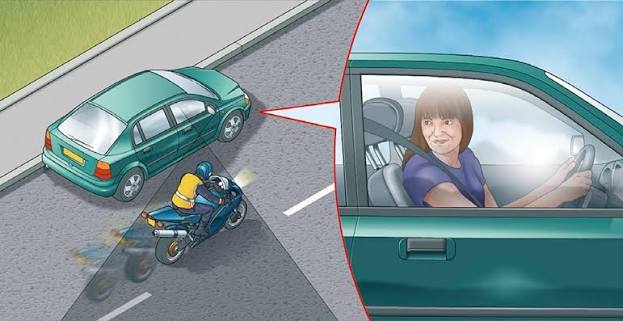
Motorcycles can disappear from a driver’s view more easily than larger vehicles, especially beside the rear quarter of a car, SUV, or truck. Checking mirrors carefully and adding a quick shoulder check before changing lanes can reduce the risk of moving into an occupied space.
The key is understanding that an empty-looking mirror does not always mean the lane is clear.
Why Motorcycles Are Easy to Miss
Motorcycles have a narrow profile and occupy less visual space than cars. At certain angles, a rider may be hidden by a mirror housing, door pillar, or the blind area beside the vehicle.
Distance can also be difficult to judge at a glance. Drivers who expect to see a full-size vehicle may overlook a motorcycle that is approaching within the same traffic stream.
Use Mirrors as the First Check, Not the Only Check
Mirrors provide useful coverage, but they cannot show every area around a vehicle. Before moving sideways, check the appropriate mirror, activate the signal, and look briefly over your shoulder when conditions permit.
Discussions about fleet driving practices often emphasize repeatable routines, and the same idea helps ordinary drivers. A consistent mirror-signal-shoulder-check habit is more reliable than depending on memory only when traffic feels busy.
Signal Before You Start Moving
A turn signal should communicate your intention before the lane change begins. Signaling after the vehicle is already drifting gives nearby riders little useful warning.
Allowing a short gap between signaling and moving also gives another road user time to react if they are positioned where you cannot see them easily.
Give Riders More Space
Motorcyclists may adjust their lane position to avoid potholes, debris, standing water, or rough pavement. Those movements can appear sudden from inside a larger vehicle even when the rider is responding to road conditions.
Keeping enough space and paying attention to road condition planning can make those movements easier to anticipate. Drivers should avoid squeezing riders toward the edge of a lane or assuming they will remain perfectly centered.
| Driving Moment | Possible Blind-Spot Issue | Better Habit |
|---|---|---|
| Lane change | Rider beside rear door | Shoulder check |
| Merging | Motorcycle approaching quickly | Recheck mirror |
| Turning | Rider alongside vehicle | Pause and scan |
| Heavy traffic | Rider partly hidden | Increase awareness |
Vehicle Condition Still Matters
Dirty windows, damaged mirrors, poor lighting, or badly adjusted mirrors can reduce the information available to the driver. Keeping glass clean and mirrors correctly positioned makes routine observation easier.
Drivers should also include tire condition awareness in normal vehicle upkeep. Stable steering and predictable braking support safer responses when another road user appears unexpectedly.
Where Drivers Commonly Go Wrong
A frequent mistake is checking the mirror once and assuming the information stays valid. Traffic continues moving during the seconds between a mirror check and the actual lane change.
Another problem is relying completely on blind-spot monitoring technology. Driver-assistance systems can be useful, but they should support direct observation rather than replace it.
Some drivers also accelerate or drift toward the lane line before checking fully. That reduces the time available to correct the maneuver if a motorcycle is already beside the vehicle.
Frequently Asked Questions
Where are motorcycles most likely to disappear from view?
They can be difficult to see beside the rear quarters of a vehicle, particularly when positioned just outside normal mirror coverage. Exact blind areas vary with vehicle size, mirror adjustment, and seating position.
Is checking the side mirror enough before changing lanes?
No. Mirrors are useful, but a brief shoulder check can reveal a vehicle that is sitting outside the mirror’s field of view. Drivers should also signal and reassess traffic immediately before moving.
Why can motorcycle speed be difficult to judge?
Their smaller visual profile can make distance and closing speed harder to estimate. Waiting an extra moment before turning, merging, or changing lanes can prevent a rushed decision based on an uncertain judgment.
Build a Repeatable Checking Routine
Motorcycle safety improves when drivers stop treating blind-spot checks as optional. Use mirrors, signal clearly, check over your shoulder, and reassess before crossing the lane line.
The routine takes only a moment, but that moment can reveal a rider who would otherwise remain hidden until the maneuver has already begun.


