Why rooftop mechanical equipment is the most common source of roof leaks that have nothing to do with the membrane itself, and how proper curb detailing and traffic management prevent it.
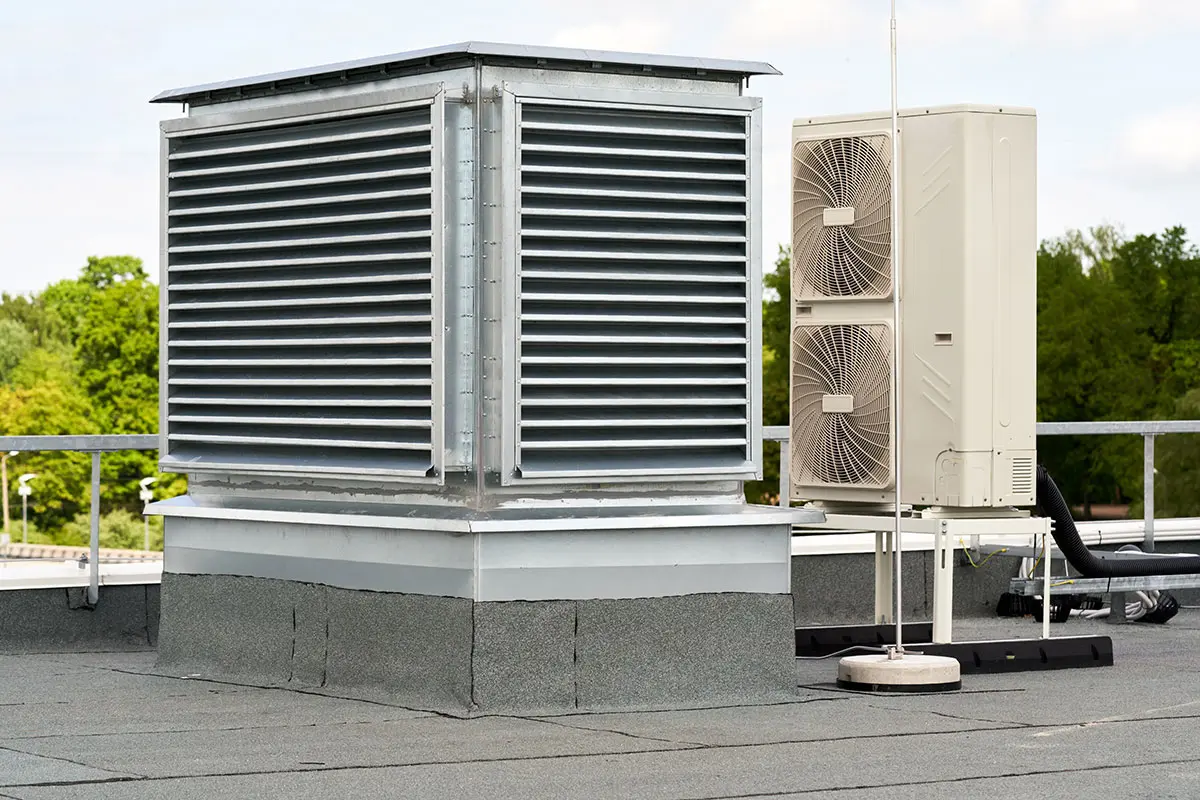
Ask a commercial roofing contractor where most non-weather leaks originate and the answer is rarely the open field of membrane. It’s around the rooftop units: the HVAC equipment, exhaust fans, and mechanical curbs that penetrate the roof to serve the building below. Every one of those units is a planned hole in the waterproofing, and the seal around that hole depends entirely on detailing quality, and stays dependent on it for as long as the equipment sits there.
This article covers how rooftop HVAC and RTU equipment interacts with the roof assembly around it: curb detailing that holds up over time, the penetration seals that fail quietly, and the service traffic damage that accumulates every time a technician walks the same path to reach a unit. None of this is exotic. It’s the maintenance-adjacent detail that gets overlooked because the roof and the mechanical system are usually managed by two different trades who rarely talk to each other.
Curbs: the foundation every RTU sits on
A rooftop unit doesn’t sit directly on the membrane. It sits on a curb, a raised frame built up from the deck that lifts the unit above the roof surface and gives the membrane a vertical surface to flash up against, the same way a parapet or wall does. A properly built curb is factory-manufactured or field-built to the unit manufacturer’s specifications, flashed into the roof membrane with the same care as any other roof-to-vertical transition, and set at a height that keeps the unit clear of typical snow accumulation.
Where curbs go wrong is usually height and flashing quality, not the curb’s existence. A curb built too low gets buried in a heavy Calgary snow season, putting the unit and its base at risk of meltwater intrusion. A curb flashed with mastic and hope instead of a proper membrane tie-in is a leak waiting for the first hard freeze-thaw cycle to work the seal loose.
Why every penetration is a maintenance item, not a one-time install
A curb and its flashing are correctly sealed at installation, and that seal degrades over time regardless of how well it was done. Thermal cycling between the metal curb and the membrane, UV exposure, and the general aging of sealants around the transition all work against the seal year after year. A penetration seal that was watertight at commissioning is not guaranteed watertight five or ten years later without inspection.
This is why rooftop equipment penetrations belong on every roof inspection checklist as their own line item, not folded into a general “membrane looks fine” assessment. A technician doing an HVAC service call is focused on the mechanical equipment, not the roofing seal around its base, and most HVAC service contracts don’t include roofing inspection scope at all. The roof’s own inspection program is usually the only place these seals get checked specifically.
Service traffic: the damage nobody’s watching for
Every time an HVAC technician, electrician, or other trade walks across a roof to reach a rooftop unit, they’re putting foot traffic and often tool or equipment weight on a membrane that wasn’t necessarily designed as a walking surface. Repeated traffic along the same path compresses insulation, can abrade or puncture a membrane over time, particularly around fasteners or seams, and on single-ply systems especially, concentrated point loads from dropped tools or dragged equipment cause damage that isn’t always immediately visible.
This damage accumulates invisibly because it’s rarely anyone’s specific job to notice it. The HVAC contractor’s focus is the equipment. The building’s general maintenance staff may not walk the roof regularly. The roofing contractor typically isn’t present for every mechanical service call. The result is a roof that takes small, repeated damage from routine mechanical service, with nobody tracking the cumulative effect until it shows up as a leak.
Walkway pads: a small investment that changes the pattern
Designated walkway pads, purpose-built traffic protection laid along the routes technicians actually use to reach rooftop equipment, address the service traffic problem directly. A pad distributes point loads across a wider area, protects the membrane from abrasion and puncture, and, just as usefully, defines a clear path that keeps foot traffic concentrated on protected surface rather than wandering across the unprotected field.
- Map the actual traffic pattern to each rooftop unit, not a theoretical straight line, since technicians take the path that’s actually easiest to walk.
- Install walkway pads rated for the expected traffic and compatible with the existing membrane system.
- Extend pad coverage around the full working perimeter of each unit, not just the approach path, since service work happens on all sides of the equipment.
- Inspect and replace worn walkway pad sections as part of the regular roof maintenance cycle, since a worn-through pad stops protecting anything.
The cost of installing walkway pads is small relative to the membrane repair or premature replacement that unmanaged traffic damage eventually causes, and it’s one of the more straightforward additions to fold into a re-roof or a maintenance program.
Coordinating roofing and mechanical trades
The recurring theme in rooftop equipment damage is a coordination gap between the mechanical trade servicing the equipment and the roofing trade responsible for the membrane it sits on. Closing that gap doesn’t require an elaborate process. It requires a property manager who treats rooftop equipment installation and service as roofing-adjacent events, not purely mechanical ones.
Practical steps include requiring any HVAC contractor installing new rooftop equipment to coordinate curb and flashing work with a roofing contractor rather than self-performing the roofing tie-in, flagging any penetration seal concerns found during HVAC service calls to the roofing maintenance provider, and including penetration and curb inspection explicitly in the roof’s own maintenance scope rather than assuming the mechanical trade is watching it. A building with this coordination in place catches curb and penetration problems on a roofing inspection cycle instead of discovering them as an active leak.
Protecting the roof during an equipment swap
Rooftop unit replacement is one of the higher-risk moments for roof damage, and it’s worth planning around specifically rather than treating as a routine mechanical swap. Cranes lifting old and new units on and off the roof concentrate significant point loads at rigging locations, and a crane mat or spreader plate should be used to distribute that weight rather than setting rigging directly on the membrane. The old unit’s removal often reveals the curb and flashing condition for the first time in years, which is useful information but also a moment where the exposed membrane needs protection until the new unit and its flashing are complete.
Coordinating the timeline between the mechanical contractor and a roofing contractor during a unit swap, so the roofing side is on hand to inspect and re-flash the curb as soon as the old unit is off and before the new one goes on, closes the gap where a rushed mechanical-only swap tends to leave a curb re-used without inspection or a flashing detail patched rather than properly redone. This coordination costs little to arrange and prevents the single most common way an HVAC replacement project turns into a roofing leak months later.
Keeping a roof plan that shows every unit
A simple but often-missing tool is a current roof plan diagram showing the location of every rooftop unit, curb, and penetration, tied to the equipment inventory and maintenance schedule. Without it, a property manager coordinating a mechanical service call has no easy way to tell the roofing contractor which specific curbs and penetrations were serviced during a given visit, and inspection reports end up describing locations vaguely rather than pinning them to a specific, repeatable reference point.
A roof plan updated whenever equipment is added, removed, or relocated turns every future inspection and every future service call into a documented event tied to a specific spot on the roof, which is exactly the kind of record that speeds up diagnosis when a leak eventually shows up near a cluster of rooftop equipment and nobody can immediately say which unit was serviced most recently.
The roof and the equipment on it need to be managed together
Rooftop HVAC and mechanical equipment are a permanent fixture on nearly every commercial low-slope roof, and the curbs, penetrations, and service traffic around them are one of the most common sources of leaks that have nothing to do with the membrane’s own material or age. Proper curb height and flashing, a maintenance program that inspects penetration seals specifically, and walkway pads along service traffic routes address the problem at its source.
A crew focused on how rooftop curbs get detailed in Calgary coordinates with the mechanical trades servicing rooftop equipment so the roof and the systems it supports stop working against each other.
About the author: this article was contributed by Superior Roofing Ltd., Calgary commercial roofing specialists with Red Seal Journeymen and 25+ years detailing rooftop curbs, penetrations, and traffic protection. The team is authorized for Carlisle and Sika systems and carries $10 million in liability coverage.